Your Intuition Is Your Expertise, Compressed
That gut feeling when parking, or when a "small tweak" email lands. It isn't magic. It's your expertise, compressed into a single moment.
You pull up to a parking spot and you just know you'll fit. You haven't measured anything. You have no data. You've never parked there before. One glance and you know.
That feeling has a name. It's intuition. And in our line of work, it might be the single most undervalued instrument we own.
Different traditions have different views on where intuition comes from, whether spiritual, scientific, or cultural. They tend to agree on what it does to the body when intuition shows up.
In the agency-client world there are three sentences everyone has heard: just a small tweak, the final version, a quick call. None of them ever mean what they say.
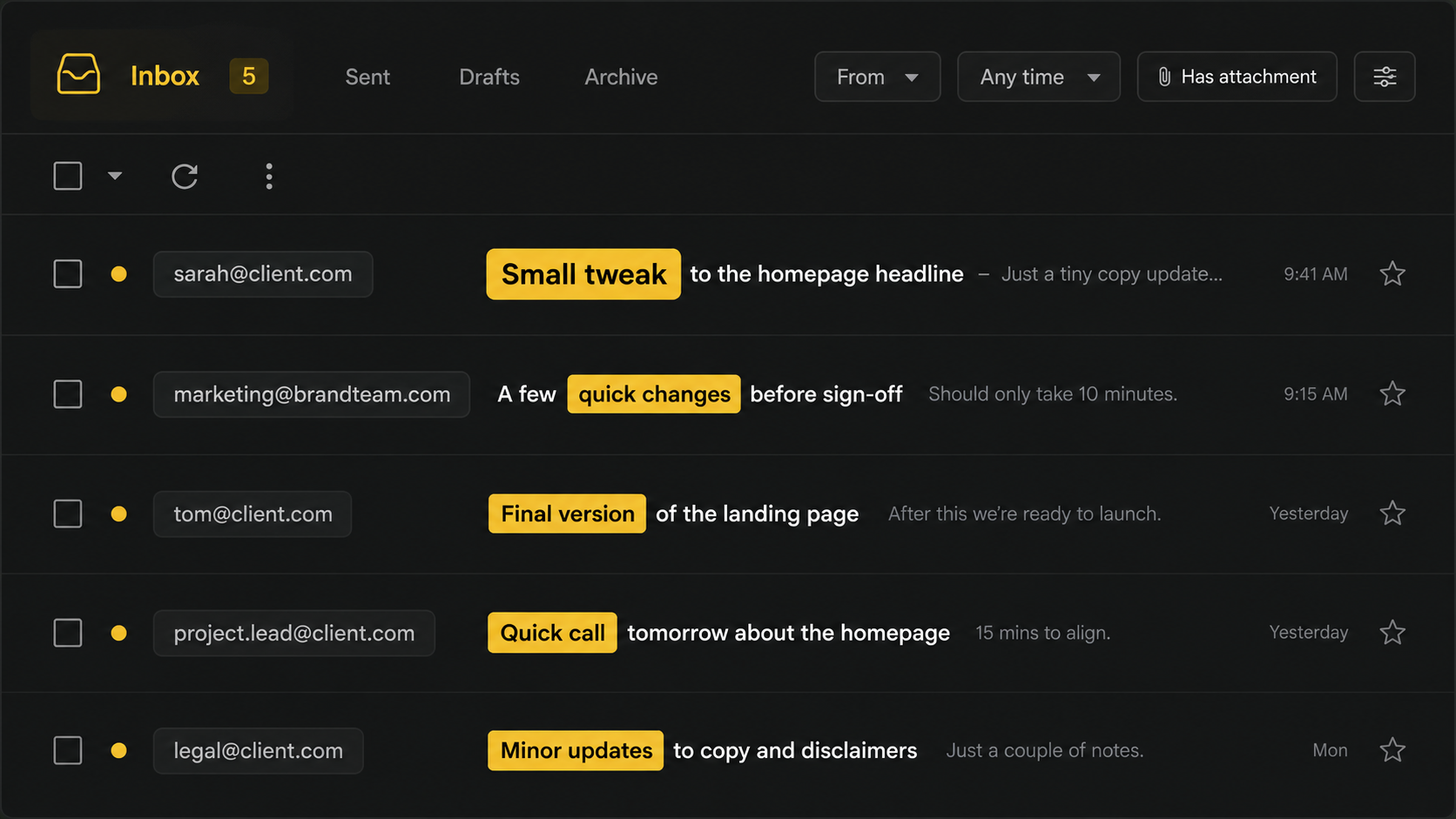
When an email with "small tweak" in the subject line lands in my inbox, the split-second I see it I already know it won't be a small tweak. It'll be a whole new project. Pressure builds in my chest. My heart rate picks up. None of that comes from analysis. It arrives before analysis is even possible.
So what is it?
Einstein had a line about looking at something long enough that you start to see patterns that were always there. The moment of recognition is intuition.
Michael Polanyi, the British-Hungarian philosopher, put it more usefully in his book The Tacit Dimension: we know more than we can tell. There's knowledge we possess but cannot fully put into words. He called it tacit knowledge, the kind of knowing that lives in our hands and bodies more than in our explanations. I know how to park, but I can't articulate what I used in that half-second to judge the spot.
We perceive, and we know, more than we can say.
The neurologist Antonio Damasio added something important to this picture. In his book Descartes' Error, he describes patients whose brain damage had taken away their ability to feel emotions. Their logic was intact, but they couldn't make decisions. Not even small ones. Choosing between two appointment dates could take half an hour of pros and cons that never resolved.
Damasio's explanation became known as the somatic marker hypothesis. When we face a decision, our body sends signals. A faster pulse. An uneasy stomach. A sense that something is off. These signals are built up from past experiences, and they guide us before we have time to think anything through. Damasio's patients had lost access to them, and without them, they were stuck. His conclusion: emotions are not the opposite of rational thinking. They are what makes rational thinking possible.
More recently, neuroscientists have framed this through predictive processing. The brain isn't passively receiving information from the world. It's constantly generating predictions about what should happen next, then comparing those predictions against incoming reality. When the gap is large, you feel it before you can name it. That uneasy feeling in a meeting is your prediction engine flagging a mismatch your conscious mind hasn't caught up to.
So whether you look at it through Polanyi, Damasio, or modern neuroscience, the same thing keeps coming back. The hunch when parking. The pressure in the chest when the email arrives. It isn't magic.
Intuition is your expertise, compressed into a single moment.
Your brain quietly stores everything you've ever lived through. Every project. Every mistake. Every meeting. Every encounter. It collects patterns, and when a similar situation appears, your body sends a signal before your conscious mind can name what it has just recognised.
When someone calls a website "intuitive," that phrasing is slightly off. The site isn't intuitive. The person using it is. What they really mean is: I, as a human, could navigate this by relying on my own intuition. So our job is the opposite of what the word suggests. The more I put intuition into what I'm working on, the less I demand it from the users. That's the mark of work done well.
A site only fails when the user has to switch their own intuition on to figure out where to go next. That's a failure of the designer's intuition.
When a client pays us, they're really paying for that. So their customers don't have to think.
There's a second reason this matters, and it's getting more urgent.
Anyone who works with AI knows the feeling. The output is close. Very close. But not quite there. We can sense it before we can explain it. AI is excellent at generating, and it gets better every week. But it's weak, structurally weak, at the feeling of this isn't good enough yet.
This is where the counterbalance forms. The more AI generates, the more we'll need people who can say this still isn't it. And "this still isn't it" is intuition. It's a biological capacity. AI doesn't have a body, doesn't have emotions, doesn't have an inner sense that something is off. That's why I think intuition will matter ten years from now in everything we do, possibly more than it does today.
If intuition is the residue of everything we've absorbed, then it isn't a talent. I think it's like a muscle, and it can be trained.
More than ten years ago, when we didn't have a company yet and were still freelancing, Palo and Jakub came to me with a question. We later co-founded Echt together. The question was: would I build the website for the country's largest mobile operator?
I didn't know what I know now. More importantly, I didn't really know how to code, which is somewhat important when someone asks you to build them a website. The brief was enormous. The responsibility was enormous. Logic told me immediately that this was insane. But something else, quieter, harder to argue with, told me I could do it. That this was the direction. So I said yes and started learning. Late nights, around my day job, problem after problem. I built it, and it wasn't very good. But the three of us ended up founding a company together. The same one that's celebrating its tenth anniversary today.
Now I lead digital experience for some of the largest companies in Slovakia, and with all due humility, I trust my intuition.
Daniel Kahneman, the psychologist and Nobel laureate, spent a lifetime studying one specific question: under what conditions can intuition actually be developed? Together with the decision researcher Gary Klein, who studied firefighters and chess masters, he laid out the answer in a now-classic paper called Conditions for Intuitive Expertise. They concluded you need three things.
An environment with patterns. A space where things repeat and rules apply. Klein's firefighters could read a burning building because they had seen hundreds of fires before, and similar situations played out in similar ways. Chess masters can read a board because pieces obey rules and positions repeat.
A lot of practice. Not one or two projects, but hundreds of decisions. Each one is a rep, and your brain stores the pattern even when you don't realise it. Anders Ericsson's research on expertise, which preceded the Kahneman and Klein paper, points to the same uncomfortable truth: there is no shortcut. The reps have to be real.
Feedback. You have to see what your decisions led to, and see it soon. You build a website and watch what works. You design an identity and see how it lives in the world. Without that loop, your brain never connects the decision to the outcome, and intuition never forms. This is why stock market analysts, despite enormous practice in a pattern-rich environment, never develop reliable intuition. The feedback signal is too noisy and too delayed. The decision and the outcome never quite meet.
Patterns. Practice. Feedback.
Kahneman goes one step further, and this is the part that should make us uncomfortable. If those conditions aren't met, intuition doesn't develop. Confidence does. You feel like you know. But you don't. And that's a much worse problem than not knowing, because at least the person who doesn't know is still looking.
Here is the most important part I keep coming back to. It's something that happens to every one of us.
You can spot a truly senior person not by their years or their CV, but by whether they speak up when something feels off.
The scene is familiar. Someone is presenting their work. A website, a campaign, a strategy. Doesn't matter which. You sense something isn't right. You can't put your finger on it. You can't articulate it yet. So you stay quiet.
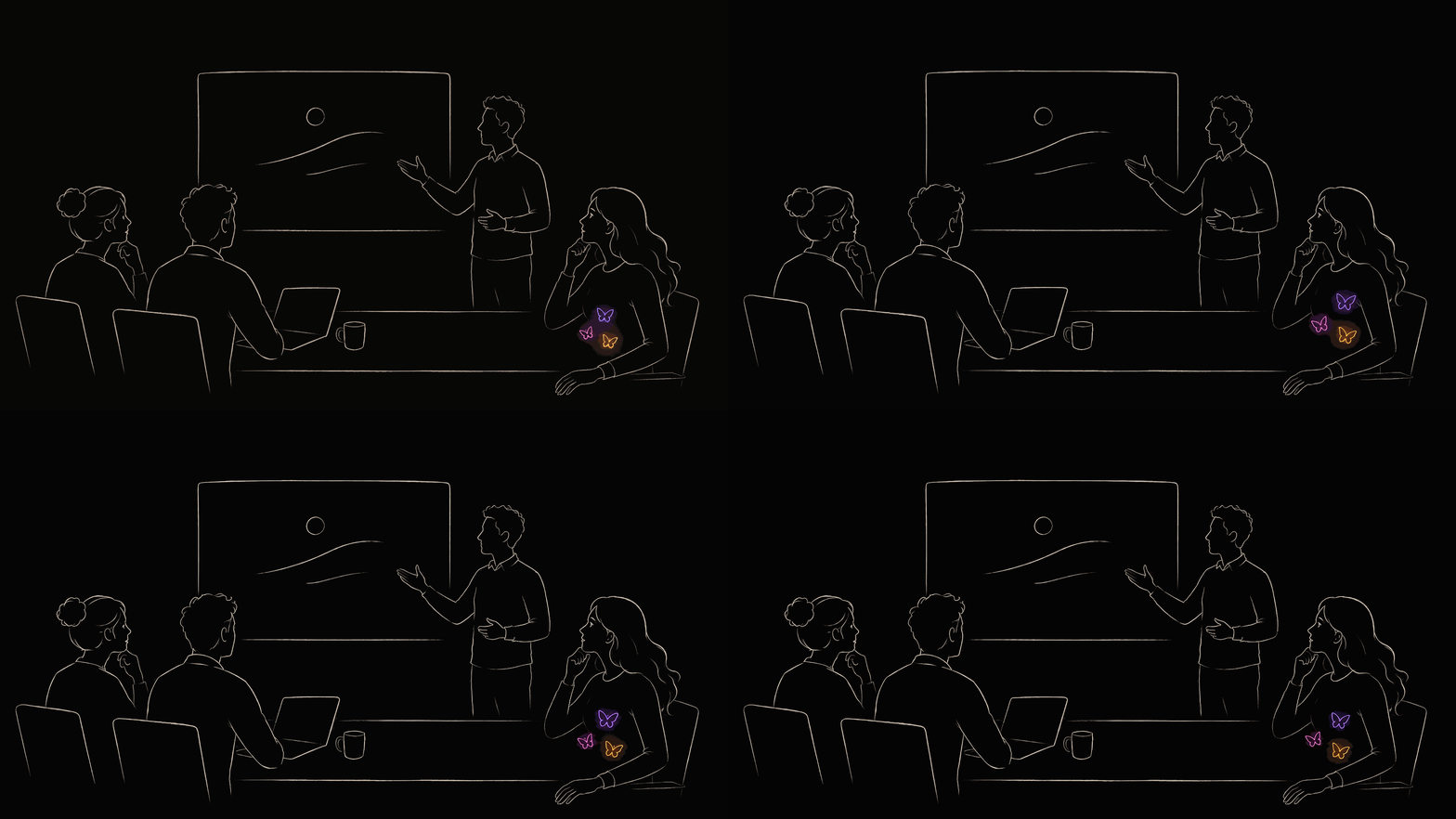
Three months later it turns out you were right. I knew it. But by then it's too late to change anything.
This happens in every company, every day, because people are afraid to speak up about something they don't have a deck for and can't back up with data. I understand the fear. In a room full of people, I just have a feeling something's off sounds embarrassing. But that feeling is your expertise compressed into a single moment. It's the most valuable thing you've got. Use it.
The worst that can happen is you turn out to be wrong.
Flip the narrative. We're far more often wrong when we say nothing.
This part is for anyone who leads people.
Think of the work as a mixing console. Each person on your team tunes their own track. If they're good at what they do, each of them has built an intuition over years. Years of decisions and feedback and quietly stored patterns.
When one of them says something feels off here, there's a lifetime of expertise behind that sentence.
Don't ignore it. Pause and ask one question.
Tell me more.
They might have just saved you six months of work. But only if you give them the room.
We live in the age of data. We measure everything, and rightly so. But some things can't be measured before they break.
So the next time you pull into a parking space and just know you'll fit, remember what that is. Every day. With every decision.
Just give it room.
And if you don't fit, well, that wasn't intuition. That was overconfidence.
If you want to read further into the ideas behind this piece:
- Michael Polanyi, The Tacit Dimension (1966). The book that gave us "we know more than we can tell." Short, dense, worth it.
- Antonio Damasio, Descartes' Error: Emotion, Reason, and the Human Brain (1994). Where the somatic marker hypothesis is laid out for a general reader.
- Daniel Kahneman and Gary Klein, Conditions for Intuitive Expertise: A Failure to Disagree. American Psychologist, 2009. The paper where two researchers from opposite camps work out when intuition can be trusted and when it can't.
- Daniel Kahneman, Thinking, Fast and Slow (2011). Chapters 21 and 22 cover the intuition argument in depth.
- Gary Klein, Sources of Power: How People Make Decisions (1998). Klein's field studies of firefighters, nurses, and military commanders. The origin of recognition-primed decision making.
- K. Anders Ericsson, Peak: Secrets from the New Science of Expertise (2016). The deliberate practice work that underlies the "ten thousand hours" idea, told properly by the researcher whose findings were popularised and somewhat distorted.
- Andy Clark, Surfing Uncertainty (2016). A readable introduction to predictive processing in the brain.